Operating forklifts, reach trucks, and other material-handling equipment in cold storage facilities creates demanding conditions for both vehicles and operators. Refrigerated warehouses combine low temperatures, moisture, repeated temperature changes, hard flooring, and long working shifts. While fleet managers often focus on batteries, hydraulic systems, tires, and other mechanical components, the operator seat also deserves careful consideration.
An industrial vehicle seat is the physical interface between the operator and the machine. Its suspension, adjustment functions, covering material, and mounting configuration can influence how comfortably and consistently an operator works throughout a shift. For logistics companies and OEMs evaluating seating for demanding applications, selecting specifications based on the actual operating environment is therefore essential.
Cold Storage Conditions and Seat Material Selection
Temperature-controlled warehouses can expose vehicle interiors to condensation and moisture, particularly when equipment moves between refrigerated areas and warmer loading or staging zones. Seats may also encounter moisture during routine cleaning or daily warehouse operations. These conditions make covering material an important consideration when specifying an industrial vehicle seat.
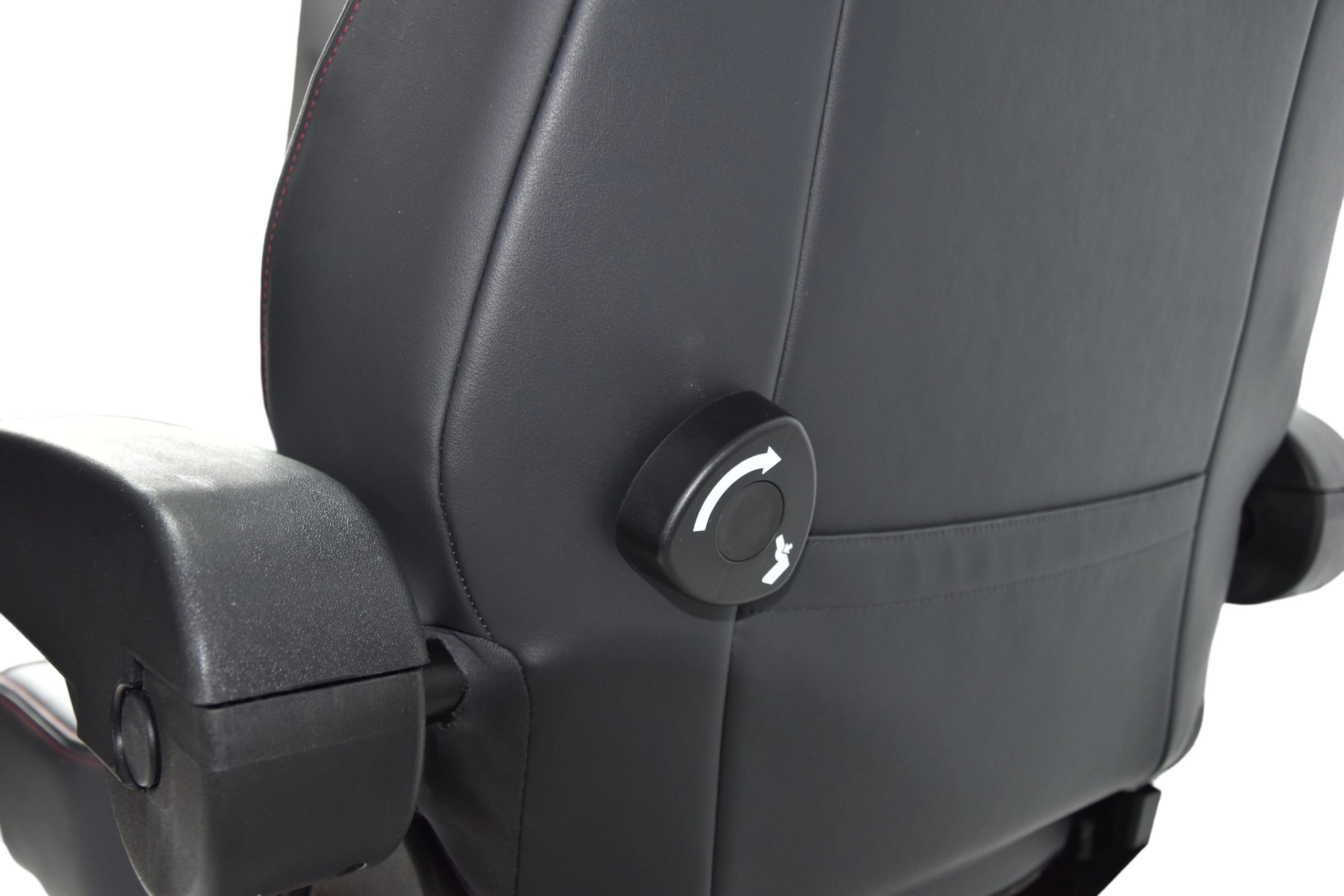
The T-BOZZ TB300, available from Source One, uses waterproof PVC covering material. This provides a practical surface option for industrial vehicles operating in environments where moisture resistance and ease of maintenance are relevant considerations.
Material selection should not be evaluated independently, however. Fleet managers should also examine suspension performance, adjustment ranges, mounting dimensions, and available options. A suitable seat needs to work as part of the vehicle’s complete operator environment rather than simply providing a comfortable surface.
Mechanical Suspension for Material-Handling Applications
Forklifts and other industrial vehicles frequently travel across hard warehouse floors, dock transitions, and uneven surfaces. Repeated movement can expose operators to vibration throughout a working shift. A mechanical suspension system can help manage this movement by allowing the seat to respond to vehicle motion.
Operator weight is a key factor for seat performance. The TB300 supports weight adjustment from 50 kg to 150 kg to accommodate operators of varying body masses. This is relevant for warehouse environments where multiple operators use the same forklift across shifts.
Suspension stroke and weight adjustment range serve as quantifiable metrics for seat evaluation, alongside visual features and physical dimensions.
Ergonomic Adjustability for Long Shifts
Cold storage operators may spend many hours seated while performing repetitive driving, loading, unloading, and positioning tasks. Because operators differ in body size and preferred seating position, adjustment capability can be an important part of seat selection.
The TB300 comes with an adjustable backrest offering a full 110° range (-40° to +70°), plus 80 mm forward and 80 mm rearward travel on fore/aft slide rails, giving operators flexibility to position the seat comfortably relative to steering wheel, pedals and all controls.
It also features three-position seat depth adjustment and three-position seat inclination adjustment, so the seating position can be fine-tuned for different operators without replacing or reworking the entire seat assembly.
For applications requiring additional lumbar support, an optional manual lumbar support with an adjustment range of more than 25 ± 5 mm is available for the TB300. Other optional accessories include adjustable armrests, headrest, two-point retractable seat belt, document bag and OPS switch. These options support configuration tailoring to specific vehicle and application requirements for OEMs and fleet operators.
Mounting Compatibility and Vehicle Integration
A technically capable seat still needs to fit the vehicle correctly. Mounting dimensions should therefore be checked before purchasing replacement seats or developing a new equipment configuration.
The TB300 has a standard mounting size of 300 × 280 mm. This provides OEMs and procurement teams with a clear dimensional reference when evaluating compatibility. The mounting structure of the individual vehicle should still be checked before installation because vehicle designs and existing mounting arrangements can vary.
For OEM projects, working with experienced industrial seating suppliers can also make the specification process more efficient. Instead of evaluating suspension, ergonomics, materials, and mounting separately, buyers can assess these characteristics as parts of one integrated seating solution.
Practical Considerations for Cold Storage Fleets
For fleet managers, selecting seats for cold storage equipment involves more than identifying a universal replacement. The expected working conditions, operator population, vehicle configuration, and maintenance requirements should all be considered.
Several specifications deserve particular attention:
- Covering material:Waterproof PVC can be relevant where moisture exposure and regular cleaning are concerns.
- Suspension:Review the mechanical suspension stroke and its compatibility with the vehicle.
- Weight adjustment:Confirm that the available range covers the intended operator group.
- Backrest and fore/aft adjustment:These functions help accommodate different operator positions.
- Seat depth and inclination:Multiple adjustment levels provide additional configuration flexibility.
- Mounting dimensions:Confirm the seat can be installed correctly on the target vehicle.
- Optional features:Consider whether lumbar support, armrests, headrests, seat belts, or OPS functions are required.
These criteria provide procurement teams with measurable points of comparison and can help standardize seating specifications across larger fleets.
Source One and Industrial Vehicle Seating
For OEMs and fleet operators, the manufacturer behind the seat is also an important part of the purchasing decision. Source One provides industrial vehicle seating as part of its broader seating solution portfolio, supporting applications across material-handling and other non-passenger vehicle sectors.
The T-BOZZ TB300 demonstrates this product-oriented approach through its combination of mechanical suspension, weight adjustment, backrest adjustment, fore/aft movement, seat-depth and inclination settings, waterproof PVC covering, and optional components. These specifications give buyers concrete information when evaluating a seat for a particular industrial vehicle.
When comparing industrial seats manufacturers, buyers should therefore look beyond general statements about comfort. Product specifications, adjustment ranges, suspension characteristics, materials, mounting dimensions, and available OEM options provide a more practical basis for evaluating suitability.
Conclusion
Cold storage logistics presents a challenging operating environment in which operator seating should not be overlooked. Moisture exposure, repeated vibration, long shifts, and different operator requirements make practical seat specifications increasingly important.
For fleet managers and OEM procurement teams, evaluating these measurable characteristics provides a more reliable approach than relying on broad comfort claims. By matching seat specifications with vehicle configuration and operating requirements, companies can develop a more practical and consistent seating solution for demanding logistics environments.
