A fear-conditioning study can produce different freezing measurements when the context, cue sequence, shock delivery, or scoring method changes between sessions. Researchers should treat freezing as an endpoint shaped by several variables. A defined protocol can make group differences easier to interpret and simplify data review.
Standardize the Conditioning Context
Context is integral to the learned association. Visual patterns, chamber configuration, lighting, background sound, odors, handling, and other environmental cues influence conditioning and memory testing. Published mouse protocols use distinct physical contexts and help maintain consistency within each cohort.
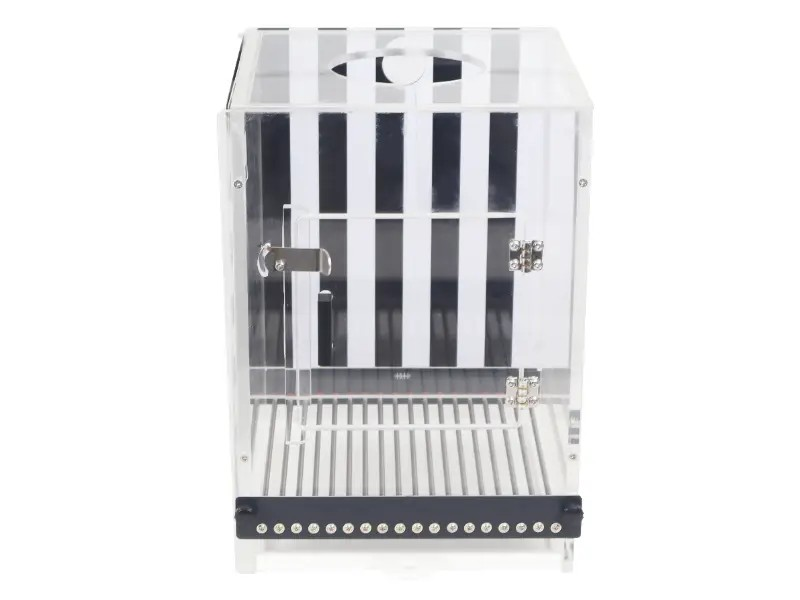
The BioMed Easy Fear Conditioning System uses interchangeable acrylic context plates with grey, white, chessboard, and vertical-stripe patterns. Its mouse chamber measures 20 × 20 × 27 cm. These features can support contextual learning and related discrimination or generalization studies.
Control the Conditioned and Unconditioned Stimuli
The cue delivered during conditioning is another source of variation. Researchers should document the type, intensity, duration, timing, and number of conditioned stimulus-unconditioned stimulus pairings.
Published protocols use different combinations of tone, context, and foot shock, so settings should remain tied to the study design rather than treated as universal values.
The SA218 supports pure tone, white noise, visible light, infrared light, and electrical foot shock. White noise and pure tone can be programmed for 0–300 seconds, with sound levels adjustable from 1–130 dB. Pure tone frequency ranges from 100 Hz to 18 kHz. Electrical stimulation is available from 0.1–4.0 mA in 0.1 mA steps.
Keep Timing and Handling Consistent
Timing can shape behavioral responses. Consider the interval between chamber placement, cue presentation, shock delivery, and post-stimulation observation. Handling and testing time can also influence the experimental environment.
Published mouse protocols have standardized testing time within cohorts and used defined handling procedures before testing.
For fear conditioning mouse studies, the written protocol should specify the session sequence, relevant intervals, handling procedure, and testing window. Consistent execution helps researchers distinguish procedural variation from changes associated with the intervention.
Define Freezing Before Scoring
Freezing needs a clear operational definition. In published mouse studies, it is commonly described as the absence of visible movement except respiration. Some experiments use continuous scoring, while others divide the observation period into predefined sampling intervals.
Automated analysis can reduce manual scoring workload while preserving a continuous behavioral record. The SA218 captures behavioral activity with an infrared HD camera at up to 1920 × 1080 resolution and 30 frames per second.
Its analysis software evaluates movement patterns for freezing assessment and differentiates sustained immobility from slow horizontal head movements.
Choose the Right Freezing Metrics
Percentage of freezing time may not answer every research question. Researchers may also examine freezing duration and frequency, onset time, or the longest freezing interval.
The SA218 automatically records total freezing duration, percentage of freezing time, number of freezing episodes, first freezing duration, longest freezing duration, freezing onset time, freezing bout frequency, and experiment duration. Multiple endpoints give researchers more flexibility during analysis.
Separate Contextual and Cued Tests
Contextual and cued fear conditioning address different learned associations. Contextual testing examines fear associated with the environment, whereas cued testing evaluates responses to a defined cue such as a tone. A protocol may therefore require distinct contexts, cue-delivery settings, or both.
The SA218 supports contextual and cued fear conditioning. Its interchangeable contextual plates provide several visual patterns, while its stimulus system supports auditory, visual, and electrical cues.
Check Recording and Integration Needs
Freezing data become more useful when behavioral events can be reviewed alongside the experimental record. The SA218 displays video, animal condition, score, and stimulation state simultaneously. Real-time analysis and preview are available, with automatic data and video saving. Raw data can be exported in CSV or DOC format.
The system also provides TTL output for synchronization with external neuroscience equipment, including optogenetics, fiber photometry, calcium imaging, EEG recording, and electrophysiology acquisition.
Multi-channel configurations can be expanded to 16 channels, with each modular slave unit operating as an independent single-channel system.
Build a Traceable Workflow
Freezing behavior is easier to interpret when the conditions that produced it are documented. Record context, cue parameters, shock settings, timing sequence, scoring definition, and animal or session identifiers. This gives the dataset a clearer experimental history and makes procedural differences easier to investigate.
BioMed Easy Technologies develops laboratory animal and neuroscience research equipment within the SANS Biotechnology group. It lists a 2016 founding year, CE and ISO9001 certifications, and global support for 3,000+ laboratories.
Its portfolio includes Motor Coordination, Pain and Inflammation, Learning & Memory, Anxiety, Fear & Emotion, and Reward & Addiction, along with related categories.
For fear conditioning mice studies, the SA218-M is the mouse configuration of the Fear Conditioning System. With programmable cue and shock settings, automated behavioral recording, interchangeable contextual plates, and synchronization interfaces for external equipment, the system can be configured around different experimental workflows.
The BioMed Easy team can help configure the system, arrange training, and plan support around a specific fear-conditioning study.
