Electrical protection is a fundamental consideration in any power distribution or control system. For decades, fuses have provided a simple and effective method of interrupting excessive current. However, as electrical installations become more complex and downtime becomes more costly, many projects are giving greater attention to resettable circuit protection devices such as miniature circuit breakers and other types of circuit breakers.
This shift does not mean that fuses have become obsolete. Instead, it reflects the need to select protection equipment according to maintenance requirements, operating conditions, system design, and long-term service efficiency. For professionals sourcing electrical control products, understanding the differences between these technologies can help create more practical and maintainable installations.
How Fuses and Resettable Protection Differ
A traditional fuse operates through a fusible element that melts when current exceeds its designed limit. Once the fuse operates, the element must be replaced before the circuit can return to service. This mechanism is straightforward and remains useful in many applications where compact overcurrent protection is required.
Resettable circuit protection devices work differently. When an overload or short circuit occurs, a circuit breaker trips to disconnect the affected circuit. After the fault has been identified and resolved, the breaker can generally be reset without replacing the protective component.
For installations where equipment needs to return to operation quickly, this difference can have practical value. Maintenance personnel can restore a protected circuit more efficiently while also identifying the affected circuit through the breaker position.
Why Miniature Circuit Breakers Fit Modern Installations
A miniature circuit breaker application is common in low-voltage distribution systems where space, accessibility, and maintenance efficiency are important. MCBs are designed to respond to overloads and short circuits, helping protect conductors and connected equipment.
Compared with replacing individual fuses, resetting an MCB can simplify routine maintenance. Its modular form also makes it suitable for distribution boards where multiple circuits need to be arranged in a compact and organized manner.
However, choosing an MCB should not be based only on physical dimensions. Rated current, voltage, breaking capacity, pole configuration, trip characteristics, installation method, and applicable standards all need to correspond to the actual circuit. A correctly selected circuit protection device should match both the electrical characteristics and the expected operating environment.
Where Fuse Bases and Fuse Holders Still Make Sense
Although resettable protection is increasingly common, fuse-based solutions remain relevant. A fuse base can provide a practical mounting and connection point for fuses, while a base mount fuse holder can support organized installation and convenient fuse replacement.
MAXGE includes Fuse Base & Links within its industrial device portfolio, alongside products such as AC contactors, thermal relays, magnetic starters, motor protection circuit breakers, and pushbutton and limiting switches.
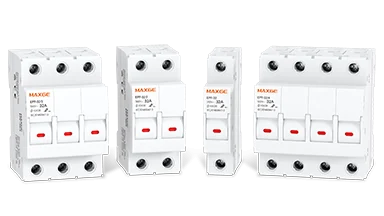
MAXGE’s EPF-32 series, for example, is a DIN-rail fuse holder designed for 10×38 mm fuses, with 1P to 4P configurations and rated operational current from 2 A to 32 A. The series is specified to IEC 60947-3 and includes TÜV, CE, and CB certifications.
This makes fuse holders particularly relevant where fuse-based short-circuit protection remains appropriate or where a project requires a specific fuse coordination strategy.
What Should Be Considered When Selecting Protection?
The right protection method depends on the application rather than simply choosing between a fuse and a breaker. Engineers and purchasing teams should first consider the circuit’s rated current and voltage, prospective short-circuit current, load characteristics, coordination requirements, available installation space, and maintenance procedures.
For frequently serviced distribution systems, resettable breakers can reduce the need for replacement components. For applications requiring specific fuse characteristics or compact fault interruption, fuse-based protection may remain the better option.
It is also important to consider the complete protection system. MAXGE’s current product portfolio covers MCBs, RCDs and RCBOs, MCCBs, ACBs, new energy devices, smart breakers, distribution boxes, and industrial devices, allowing protection components to be selected according to different circuit requirements.
Choosing Electrical Control Products for Long-Term Use
Modern electrical projects increasingly consider not only initial installation, but also maintenance, troubleshooting, system coordination, and operational continuity. This broader perspective makes factors such as reset capability, accessibility, monitoring, and replacement requirements increasingly relevant when developing a protection strategy.
Reliable electrical design does not depend on one type of component. Different circuits and operating environments may call for different protection approaches, and the objective is to combine suitable devices according to the electrical characteristics and maintenance requirements of the system. MAXGE develops low-voltage electrical solutions for residential, commercial, and industrial applications, with its protection and control solutions also extending to PV, energy storage, and EV charging systems.
Its product development is supported by an R&D team, smart manufacturing, and automated production at its Deqing and Wuhu manufacturing bases, with more than 90% automation. Patented technologies, software copyrights, CNAS-related laboratory capabilities, and international certifications further support its product development and testing activities.
For project requirements, product specifications, or application support, professionals can contact MAXGE directly through its official website. Considering circuit conditions, protection requirements, maintenance practices, and future system needs together can help create an electrical protection strategy that remains practical throughout the service life of the installation.
