Ethernet switching is moving beyond the traditional goal of simply connecting devices. As AI workloads, edge computing, industrial automation, and increasingly distributed infrastructures reshape network requirements, switch manufacturers are being pushed to deliver higher bandwidth, better efficiency, stronger resilience, and more intelligent management. For an ethernet switch OEM, these changes are creating opportunities to rethink both hardware design and the capabilities built into network equipment.
Higher Speeds Will Reshape Ethernet Switch Design
Bandwidth growth is likely to remain one of the defining directions for Ethernet innovation. The Ethernet Alliance’s 2026 roadmap identifies 100G to 800G interconnects and emerging 1.6 Tb/s Ethernet as important developments, particularly for AI, cloud, and high-performance networking. Enterprise environments are also moving toward 2.5G, 5G, and 10GBASE-T with faster optical uplinks.
For switch manufacturers, this progression affects more than port speed. Higher throughput places greater demands on switching silicon, optical modules, thermal management, power delivery, cabling, and system architecture. Future products will therefore need to balance performance with practical deployment costs, energy consumption, and interoperability.
Optical connectivity will remain especially important as network distances and bandwidth requirements increase. The Ethernet ecosystem is developing new copper and optical approaches alongside technologies such as Linear Pluggable Optics. These developments indicate that future switch platforms will increasingly need flexible support for different physical-layer technologies rather than relying on one connectivity method.
Smarter Industrial Switching Will Become More Important
Industrial networking presents a different challenge from hyperscale data centers. Manufacturing facilities require stable communications across equipment exposed to vibration, electromagnetic interference, temperature changes, and other demanding conditions. At the same time, automation systems increasingly depend on timely data exchange between machines, controllers, sensors, and management platforms.
Time-sensitive networking (TSN) is one technology influencing this direction. The Ethernet Alliance identifies TSN, BASE-T1, and converged 5G, Wi-Fi, and Ethernet as important elements of future industrial networking and real-time automation.
This trend means an ethernet switch OEM may increasingly compete on network control capabilities as well as physical specifications. Centralized configuration, traffic monitoring, diagnostics, and management can help network operators identify problems faster and maintain more predictable communications across industrial environments.
Wintop’s Layer 2 managed switch portfolio illustrates this approach. Its managed switches are designed to help users expand industrial networks while configuring, monitoring, and managing traffic through a centralized interface.
Efficiency Will Influence Future Switch Development
Performance cannot be separated from energy consumption. As network speeds increase, equipment designers face greater pressure to deliver more bandwidth without creating proportionally greater power and cooling requirements. The Ethernet Alliance’s latest roadmap specifically highlights bandwidth-per-watt, improved cooling, and advanced power management as important areas of development.
This consideration is particularly relevant to industrial applications, where switches may operate continuously and be installed in locations with limited cooling infrastructure. Fanless designs, efficient components, and appropriate thermal engineering can therefore become meaningful differentiators.
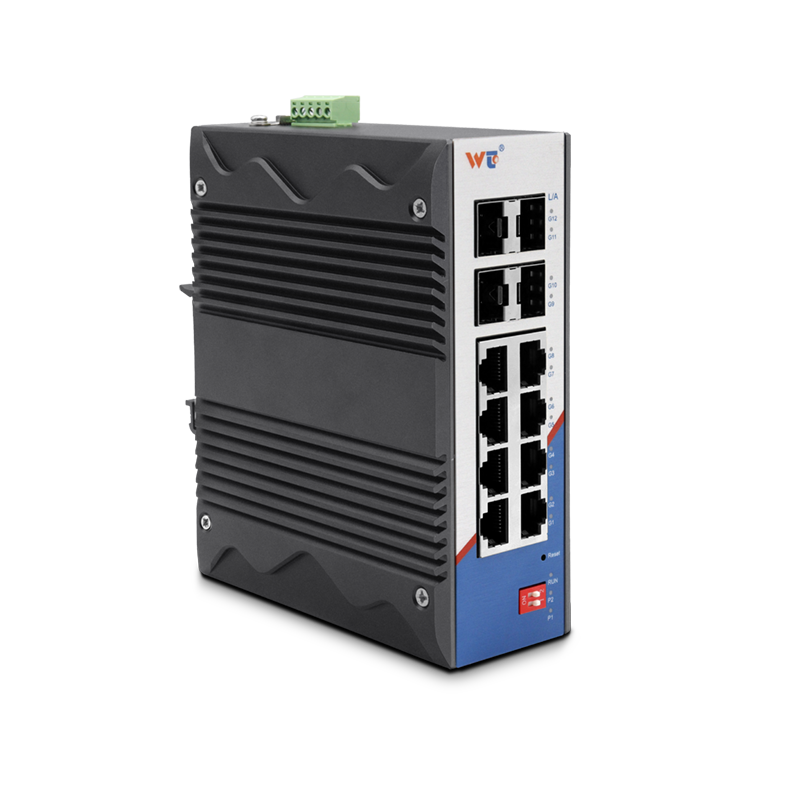
Wintop’s RS6312-4GF8GT provides an example at the industrial switching level. The Layer 2 managed industrial Ethernet switch combines eight 10/100/1000BASE-T RJ45 ports with four 1G SFP ports. Its fan-free, low-power design is intended for industrial network deployments where operating stability and physical robustness matter.
Reliability and Environmental Protection Will Stay Critical
Future innovation will not make basic reliability less important. Rather, as Ethernet becomes more deeply integrated into production systems and other critical infrastructure, switches will need to maintain dependable operation under demanding conditions.
The Wintop RS6312-4GF8GT is specified with an operating temperature range of -40°C to 85°C, IP40-rated protection, and industrial rating level 4. It also incorporates high EMI/EMS protection, and every unit undergoes aging tests in accordance with the supplied product specifications..
Such characteristics demonstrate why industrial Ethernet innovation is not simply a race toward higher speeds. Network equipment must be matched to its operating environment. For OEM buyers, factors such as temperature tolerance, electromagnetic protection, enclosure design, and testing can be just as relevant as port count.
AI and Edge Computing Will Broaden the Market
AI is also changing the long-term Ethernet landscape. The Ethernet Alliance reports that AI workloads are driving demand for higher-speed interconnects, while Ethernet continues expanding across AI-scale networks. Its 2026 roadmap also connects Ethernet development with edge computing, automotive systems, manufacturing, and cloud infrastructure.
For switch manufacturers, this creates a broader design challenge. Networks increasingly need to connect centralized computing resources with distributed devices and edge systems. This can increase demand for combinations of copper and optical interfaces, higher uplink capacity, intelligent management, and application-specific industrial features.
What the Next Generation of OEM Switching May Look Like
The future of the Ethernet switch OEM industry is unlikely to be defined by a single breakthrough. Instead, progress will come from combining faster interfaces, optical innovation, efficient hardware, intelligent management, industrial resilience, and support for emerging network architectures.
For industrial buyers, the practical priority will be selecting equipment that fits both present requirements and expected network growth. Wintop is a network equipment supplier and national high-tech enterprise specializing in the R&D, production, and sales of optical modules and switches. Its Layer 2 managed switching solutions include the RS6312-4GF8GT, which combines managed functionality, copper and fiber connectivity, and industrial-oriented design.
For businesses evaluating Ethernet switching solutions or planning their next-generation industrial network, Wintop can provide equipment options aligned with different connectivity and deployment requirements. Contact Wintop to discuss suitable Ethernet switch solutions for your network application and OEM requirements.
