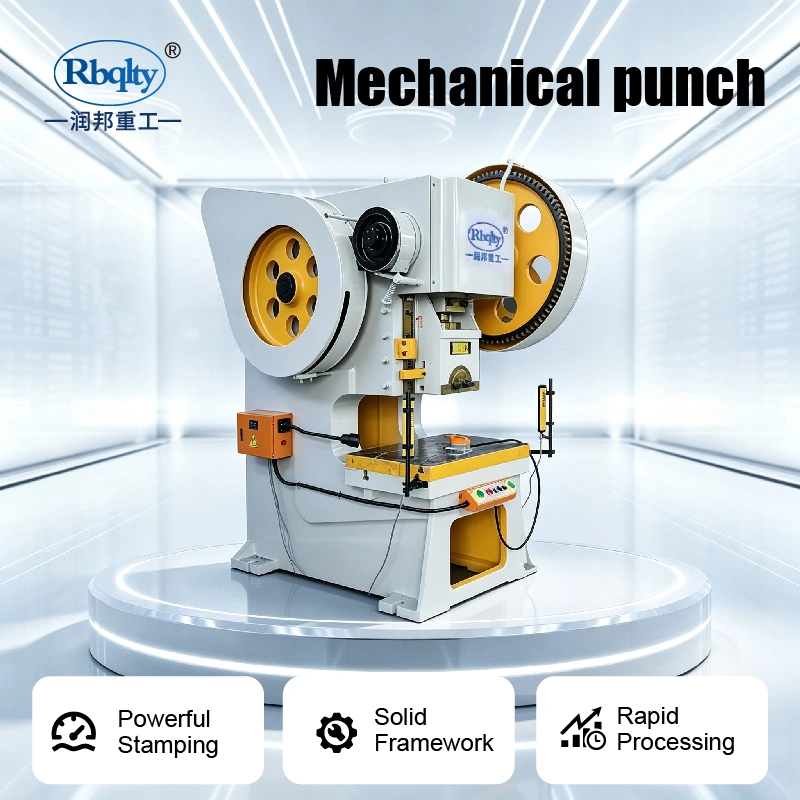
A punch press machine is an important tool in metalworking. It creates holes, slots, and shaped cutouts in sheet metal by applying force through a punch and die. Manufacturers use this process to produce components with consistent dimensions for automotive parts, electrical enclosures, construction products, and industrial machinery.
Understanding how a punch press works helps manufacturers choose suitable machinery for their production requirements. As part of modern sheet metal processing equipment, punch presses can improve processing consistency, reduce repetitive manual operations, and support efficient production.
How Does a Punch Press Machine Work?
A punch press operates by driving a punch into sheet metal supported by a die. The applied force separates or deforms the material, creating the required feature.
During a typical cycle, the operator or feeding system positions the sheet beneath the punch. The machine then drives the punch through the material and into the die opening. The resulting workpiece can move to another processing stage, while scrap is removed.
Punching performance depends on several factors, including material strength, sheet thickness, punch geometry, die clearance, and machine capacity. Correct tooling selection is essential for achieving clean edges and reducing tool wear.
Punch presses use different mechanisms to generate force. Mechanical presses rely on a motor-driven transmission, pneumatic presses use compressed air, and hydraulic presses use fluid pressure. Each design has different operating characteristics, so buyers should compare machine specifications against their intended applications.
Common Types of Punch Press Machines
Mechanical Punch Press
A mechanical punch press uses components such as a motor, flywheel, crankshaft, and ram to generate pressing motion. It is commonly used for repetitive operations such as punching, blanking, and forming.
RBQLTY offers a J23 series open-back inclinable mechanical press for general-purpose cold stamping applications. Buyers should check the specifications of the individual model to confirm its suitability for the required material and processing tasks.
Pneumatic Punch Press
A pneumatic punch press uses compressed air to operate its pressing mechanism. Depending on its configuration, it can support repetitive production and integration with automatic feeding systems.
RBQLTY also lists a pneumatic punching machine with a feeder. When evaluating this type of setup, manufacturers should consider feeding accuracy, material dimensions, tooling compatibility, and synchronization between the feeding and pressing cycles.
Turret Punch Press
A turret punch press holds multiple tools in a rotating turret. This arrangement allows the machine to select different punches during programmed operations, making it useful for components that require varied hole sizes and patterns.
RBQLTY’s RB3024-24 hydraulic turret punching machine is listed with 24 stations and four control axes: X, Y, T, and C. Its published specifications include working accuracy of ±0.1 mm and a maximum processed carbon steel plate thickness of 4 mm. These figures apply to this specific model and its stated operating conditions.
Applications in Industrial Manufacturing
Punch presses are widely used where metal components require repeatable holes or shaped features.
- Automotive manufacturing: Producing brackets, mounting plates, and stamped components.
- Electrical equipment: Creating openings in cabinets, enclosures, and mounting panels.
- Construction and engineering: Processing metal plates and components for structures and machinery.
- General manufacturing: Producing parts that require consistent hole patterns or cutouts.
The appropriate machine depends on component design, material specifications, production volume, and downstream assembly requirements. A workshop producing varied, low-volume parts may prioritize flexibility, while high-volume manufacturers may benefit from automated feeding and repeatable processing cycles.
How to Choose a Punching Press Machine
Selecting a punching press machine requires more than comparing pressing force. Buyers should evaluate the following factors.
Material and thickness: Confirm that the machine can process the intended material within its rated limits. Material strength and thickness influence the force required.
Tooling requirements: Review the required hole sizes, shapes, die clearances, and frequency of tool changes. Parts with multiple features may benefit from a turret configuration.
Production volume: High-volume operations may justify automatic feeding, while smaller batches may require a more flexible setup.
Accuracy and repeatability: Check the manufacturer’s stated accuracy and positioning specifications. Actual results also depend on tooling condition, calibration, maintenance, and material variation.
Safety and maintenance: Consider guarding, operator training, lubrication, replacement parts, and technical support. Safe operating procedures remain essential for every machine type.
RBQLTY’s Punching Solutions for B2B Manufacturers
RBQLTY integrates research and development, manufacturing, sales, and service for sheet metal processing machinery. Its product portfolio includes punching presses, press brakes, shearing machines, and grooving machines.
The company serves industries including automotive manufacturing, aerospace, shipbuilding, engineering machinery, and bridge construction. It also provides OEM and ODM manufacturing services and supports customized production according to customer requirements.
For industrial buyers, these services can be useful when standard machine configurations do not fully match production needs. Buyers should provide material specifications, component drawings, required output, and automation expectations when discussing equipment options with the supplier.
More information about available machinery and customized solutions can be found on the official RBQLTY website.
Conclusion
A punch press machine creates holes and shaped features in sheet metal through controlled force applied by a punch and die. Mechanical, pneumatic, and turret presses serve different manufacturing needs.
By evaluating material requirements, tooling, accuracy, production volume, and safety, manufacturers can select suitable punching equipment and integrate it into an efficient fabrication workflow.
