Supermarket lighting plays an important role in product visibility, shopper comfort, and store operating costs. For retail developers, facility managers, and lighting contractors, selecting the right system requires more than comparing fixture wattages. Shelf displays need consistent illumination, aisles require comfortable visibility, and back-of-house areas may have different performance requirements. A well-planned design balances these needs while supporting energy efficiency, maintenance access, and the long-term flexibility of the retail space.
Match Illumination to Shelves and Aisles
Shelf lighting should make labels, packaging, and product colors easy to distinguish without creating distracting bright spots. Aisle lighting, meanwhile, needs to provide comfortable visibility across the walking surface and the vertical faces of shelving. Designing these areas separately helps prevent a common problem: a floor that looks bright while products on the shelves remain poorly illuminated.
The Illuminating Engineering Society’s retail lighting guidance addresses both horizontal and vertical illuminance, alongside uniformity. This supports a design approach based on where light is needed rather than relying on a single average lux value for the entire store.
Before choosing fixtures, lighting designers should review ceiling height, shelf dimensions, aisle width, merchandise categories, and existing light levels. A photometric layout can then help determine fixture spacing, beam distribution, and potential dark zones before installation begins.
Choose the Right Color Quality and Glare Control
Color rendering is particularly important in fresh produce, bakery, meat, and apparel-related retail sections. A suitable color rendering index (CRI) helps shoppers distinguish product colors more accurately, although the preferred color appearance also depends on the merchandise and the retailer’s visual standards. Consistency between fixtures matters because noticeably different color temperatures can make adjacent displays look uneven.
Glare deserves equal attention. Exposed LED sources can cause discomfort when shoppers look down an aisle or toward elevated fixtures. Optics, diffusers, mounting height, and fixture orientation all affect visual comfort. Low-glare designs are especially useful in long aisles where customers repeatedly look toward shelves and signs.
Retailers should evaluate these characteristics through product data and on-site testing, rather than selecting fixtures by wattage or color temperature alone. The objective is a balanced visual environment that supports browsing without making the store feel harsh or excessively bright.
Evaluate LED Light Trunking for Flexible Layouts
For large supermarkets and building-material retailers, continuous lighting systems can simplify installation across repeated shelf rows and aisles. LED light trunking uses a trunking rail or supporting infrastructure to accommodate compatible lighting modules, depending on the system design. This approach can make it easier to plan consistent fixture spacing and maintain an organized ceiling layout.
When comparing options, buyers should examine system efficacy, optical distribution, glare performance, electrical compatibility, emergency-lighting provisions, and the availability of replacement components. A modular system may also offer flexibility when departments are rearranged, but compatibility between rails and luminaires must be confirmed rather than assumed.
For retrofit projects, the existing ceiling infrastructure is another key consideration. Reusing suitable components may reduce replacement work, installation time, and material waste. However, engineers should first inspect the condition of the existing system and verify that the proposed equipment meets the project’s electrical and lighting requirements.
Balance Energy Efficiency with Lighting Controls
A successful supermarket lighting plan considers operating hours, daylight availability, and occupancy patterns. LED fixtures can reduce lighting electricity consumption compared with older technologies, while dimming, scheduling, and occupancy-based controls can further limit unnecessary use in suitable areas.
The California Energy Commission’s Big-Box Efficiency Project evaluated an integrated package of energy-saving technologies at a Walmart Supercenter. The project reported whole-building electricity savings of 30.2% against its baseline, increasing to 32.4% when additional DC lighting savings were included. These results reflect multiple technologies, not lighting alone, but demonstrate the value of evaluating upgrades as part of a coordinated building strategy.
For buyers, the practical next step is to compare annual energy consumption under realistic operating schedules. Include fixture wattage, control settings, maintenance requirements, and installation costs in the calculation. This gives procurement teams a clearer view of total ownership cost than the initial fixture price alone.
Consider Maintenance and Total Cost of Ownership
Lighting decisions should account for more than energy consumption. Fixture lifespan, driver replacement, cleaning access, warranty coverage, and spare-part availability all affect long-term operating costs. In supermarkets with high ceilings or densely arranged shelves, maintenance can require equipment and temporary aisle closures, making serviceability a practical purchasing consideration.
A complete cost comparison should include initial equipment, installation labor, control-system integration, electricity, and anticipated maintenance over the expected service period. Buyers should also confirm whether the proposed system can be installed in phases to minimize disruption during business hours.
When assessing LED light trunking, procurement teams should ask suppliers about module replacement procedures, system expansion, and future compatibility. Clear answers help facility teams plan maintenance and avoid unnecessary replacement of otherwise serviceable infrastructure.
Learn from a Large-Scale Retail Retrofit
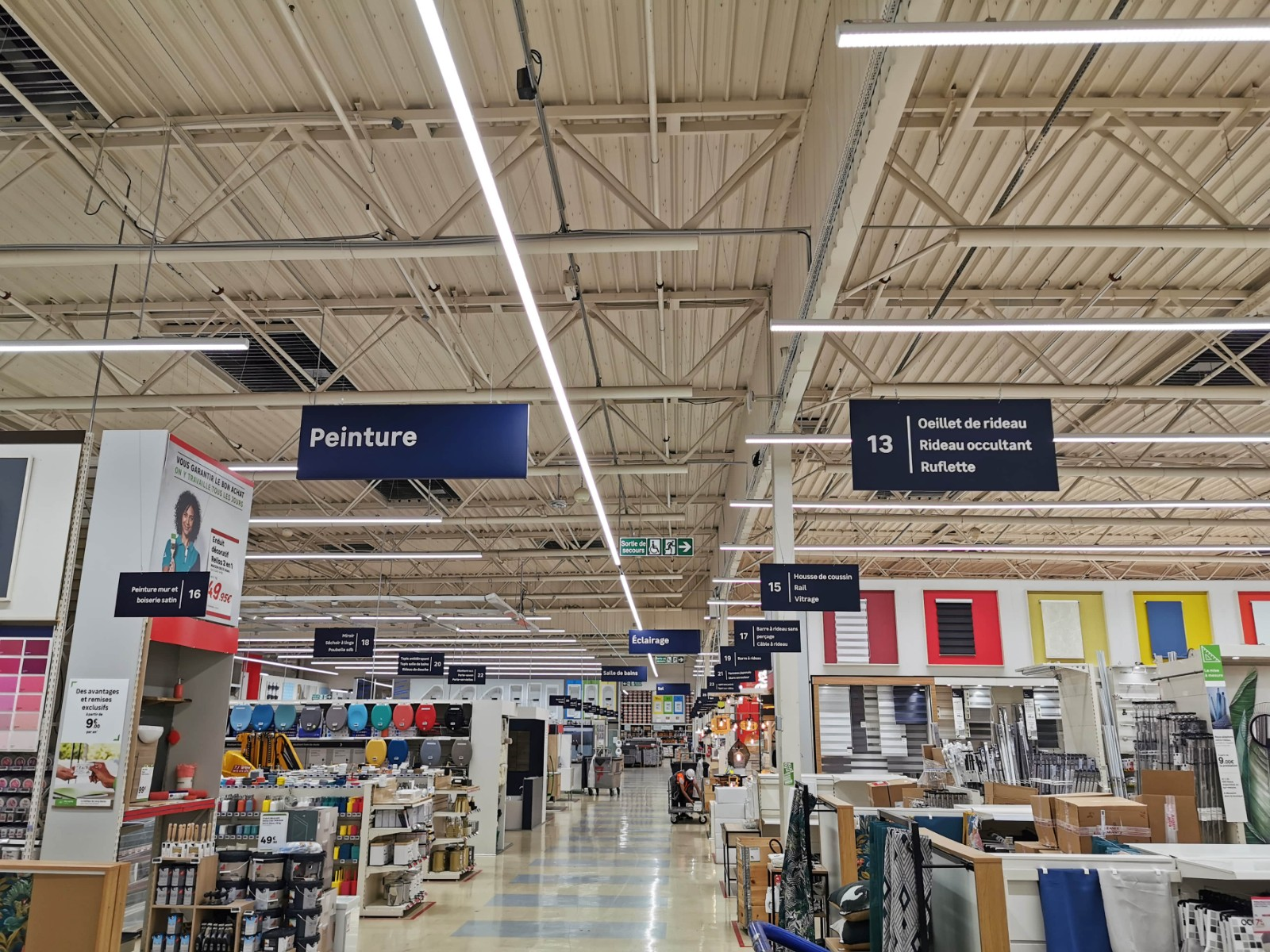
TRIECO’s Leroy Merlin building-material supermarket project in France illustrates how an integrated retrofit can address both energy performance and visual quality. The project covered a 6,000 m² retail space, using a customized, high-efficiency, low-glare trunking lighting system with intelligent dimming controls.
According to the project information provided by TRIECO, overall energy consumption was reduced by more than 50%, while an illuminance uniformity ratio of 0.9 was achieved across the shelves. The design focused on consistent merchandise visibility, reduced glare, and flexible control. These are project-specific reported results, not guaranteed outcomes for every store.
For retailers planning similar upgrades, the case highlights the importance of combining fixture selection, optical design, and control strategies. TRIECO specializes in professional LED lighting retrofits for retail and other commercial environments, making this integrated approach relevant when evaluating solutions for existing stores.
Build a Lighting Plan Around Retail Priorities
Choosing effective supermarket lighting requires a coordinated assessment of shelf visibility, aisle comfort, color quality, glare, energy use, and maintenance. Retailers should begin with site measurements and a clear lighting brief, then compare photometric designs, controls, installation requirements, and lifecycle costs before approving equipment.
For large-format stores, LED light trunking can be worth evaluating where continuous layouts and future flexibility are priorities. The right solution depends on the building, merchandise, and operating schedule rather than one fixture type alone. By combining measured performance targets with a practical retrofit strategy, retailers can create a more comfortable shopping environment while managing long-term costs. TRIECO‘s retail retrofit experience offers a relevant starting point for businesses seeking a tailored assessment.
