Professional buyers rarely judge a generator by its headline wattage alone. For construction sites, commercial facilities, farms, and backup power applications across markets such as South Africa, Ghana, and Nigeria, generator quality is a combination of dependable output, electrical stability, mechanical durability, operating practicality, and manufacturer support. A best quality generator should deliver predictable performance when loads change, remain serviceable over time, and match the application rather than simply offering the largest capacity.
Understanding Professional Generator Quality
For professional applications, generator selection starts with the intended duty. ISO 8528-1 establishes classifications for generating sets used in continuous, peak-load, and standby applications, while ISO 8528-5 addresses design and performance criteria for the generator set as an integrated unit. This makes application requirements an important part of defining quality rather than treating generator capacity as the only metric.
Power quality is equally important. Commercial equipment can include motors, pumps, compressors, lighting systems, control equipment, and electronic loads with different starting and operating characteristics. A professional generator therefore needs enough running capacity for the connected load and adequate starting capacity for equipment with higher startup demand. Buyers should also examine voltage regulation and alternator design when evaluating candidates.
Why Electrical Stability Matters
The alternator is central to a generator’s electrical performance. An automatic voltage regulator, or AVR, helps control output voltage as electrical demand changes. For professional users, this can be particularly relevant when a generator supplies equipment that requires stable power. However, AVR should not be considered in isolation; the engine, alternator, control system, and protection features work together as one generating set.
For buyers comparing power equipment manufacturers, documented specifications are more useful than broad claims such as “industrial quality.” Rated output, starting output, phase configuration, fuel type, operating noise, and other relevant parameters provide a clearer basis for comparing equipment with the requirements of a project. The best quality generator is ultimately the one whose verified performance fits the application.
Durability and Practical Design
Professional equipment is often expected to operate in demanding environments, so physical design matters. A generator intended for commercial or construction use should be evaluated for its enclosure, cooling arrangement, access for maintenance, mobility, and protection against environmental exposure. These factors can influence uptime and the practical cost of ownership over the equipment’s service life.
Noise can also affect generator selection. A soundproof or silent-canopy design can be valuable on sites where workers, nearby businesses, customers, or residents may be affected by operating noise. It does not eliminate the need for safe installation and operation, but it can make the generator more suitable for locations with tighter acoustic requirements.
Firman SDG18000SE: A Professional-Use Example
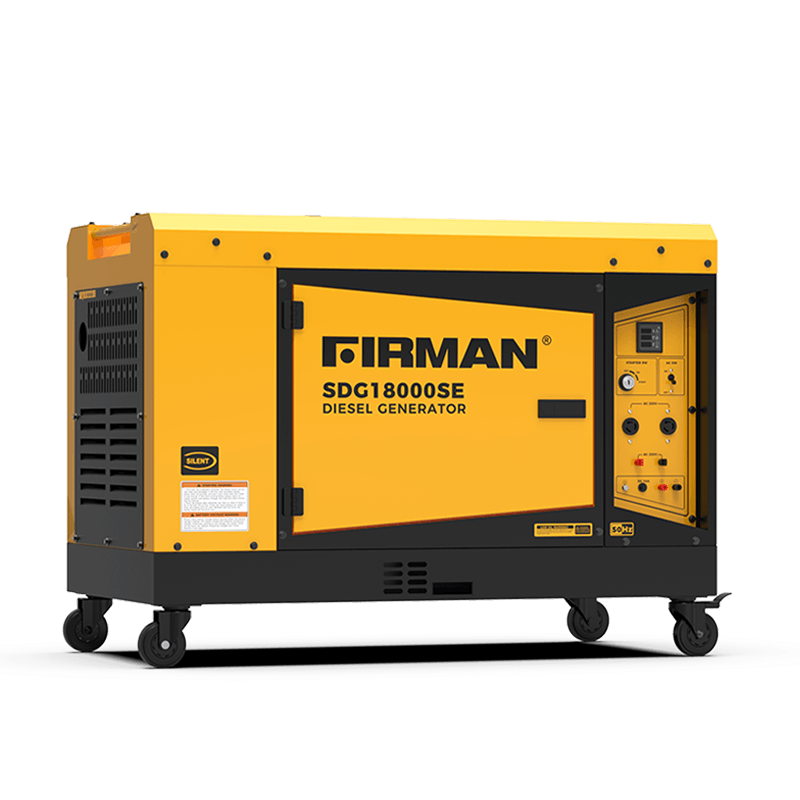
Firman provides a useful example of how these considerations can be applied to a specific diesel generator. The SDG18000SE belongs to the SDG Line Soundproof series and is designed with an electric start, battery, wheels, and a silent canopy. Its listed starting output is 16.0 kVA, while running output is 14.5 kVA, giving professional buyers clearly defined capacity figures for project planning.
Its alternator uses a brush design with AVR and 100% copper enamelled wire. The manufacturer lists an alternator specification of power factor 1.0. The set uses the SDE2V95F engine, diesel fuel, and an electric starting system. Its fuel tank capacity is 25 L, while the oil capacity is 3.2 L. These are concrete specifications buyers can use when comparing generator options.
Operating practicality is another consideration. Firman lists the SDG18000SE at 84 dB at 7 m and gives an approximate runtime of 6.4 hours on one tank at 50% load. The generator has a gross weight of 310 kg and a packing size of 1200 × 730 × 830 mm. These details matter for logistics, placement, and expectations for operation between refueling intervals.
What to Look for From Power Equipment Manufacturers
Product quality is only one part of a professional purchasing decision. Buyers should also examine the manufacturer’s quality-control practices, technical documentation, service network, spare-parts support, and ability to maintain consistent production standards. These factors can become especially important when equipment is deployed across multiple sites or incorporated into a long-term power strategy.
Firman maintains a comprehensive quality-control and risk-management system, supported by standard operating procedures and multi-step inspections. The company focuses on product research and development and provides service support. Such information does not replace application-specific testing, but it gives professional buyers additional criteria for evaluating a supplier.
A Better Definition of Generator Quality
The best quality generator is not necessarily the most powerful or the most expensive model. It is the unit that combines suitable capacity, stable electrical performance, durable construction, practical operation, and dependable manufacturer support for the intended duty. Professional buyers should therefore compare verified specifications with actual site requirements before making a purchasing decision.
For organizations evaluating power equipment manufacturers, Firman‘s SDG18000SE demonstrates how detailed specifications can support that process. Its 16.0 kVA starting output, 14.5 kVA running output, AVR-equipped alternator, 100% copper enamelled wire, diesel engine, soundproof configuration, and defined fuel and runtime figures provide measurable points for evaluation. A specification-led approach helps businesses choose equipment based on performance and application fit rather than marketing language alone.
