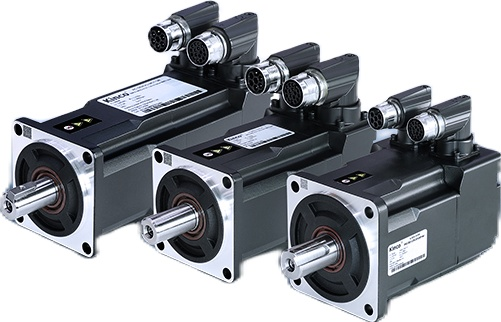
A 750-watt servo motor is often considered for machines that need controlled acceleration, repeatable positioning, and consistent speed under changing loads. Yet power rating alone does not tell engineers whether a motor fits the application. Torque, speed, feedback, drive compatibility, thermal conditions, and mounting dimensions all affect system performance.
What a 750W AC Servo Motor Does
An AC servo motor converts electrical energy into controlled mechanical motion as part of a closed-loop system. The servo drive supplies motor current, while feedback from an encoder allows the controller to regulate position, speed, or torque.
A 750W AC servo motor is a power class, not a complete performance description. Two motors with the same wattage can differ in rated torque, maximum speed, rotor inertia, voltage, flange size, and feedback options. Compare the full model specification with the load profile and the selected servo drive.
Power is linked to torque and rotational speed, so operating point matters. A motor’s ability to deliver rated power depends on its running speed. Use the full torque-speed curve for comparison, not a single headline rating.
Key Specifications to Check
Rated Torque and Speed
Torque describes the motor’s ability to produce turning force, while speed indicates how quickly its shaft rotates. A rated torque value applies under stated operating conditions. Peak torque supports short-duration demands such as acceleration, but it should not be treated as continuous output.
The SMH80S 750W model is listed with a rated torque of 2.39 Nm at 3,000 rpm. Its listed maximum speed is 6,000 rpm and maximum torque is 7.17 Nm. Actual performance also depends on the matching drive and application conditions.
Voltage and Current
The SMH80S-0075 is available in 120 VAC and 220 VAC configurations, depending on the model code. When paired with the specified FD332S drive, the system uses a 155 VDC DC link and has a rated motor current of 7.5 A. Confirm the voltage configuration and compatible drive before ordering.
Feedback and Protection
Feedback resolution affects how the control system measures shaft position. The SMH80S model includes a 2,500-pulse-per-revolution incremental encoder. The specification also lists IP65 protection for the motor body and IP54 shaft sealing. These ratings describe different areas of the assembly, so consider the shaft interface and surrounding equipment when assessing dust or moisture exposure.
The motor is described as totally enclosed and non-ventilated. A brake is an option on the series, so confirm whether the exact model code includes one if the load needs holding when power is removed.
Where 750W Servo Motors Are Used
A 750W AC servo motor can be considered for equipment requiring controlled acceleration and repeatable positioning. Potential applications include slitting machines, engraving equipment, laser cutting systems, indexing mechanisms, and automated material-handling axes, provided the required torque, speed, and duty cycle fall within the motor’s operating limits.
Other potential applications include indexing mechanisms, automated fixtures, and material-handling axes when calculated torque and speed fall within the motor’s ratings. Evaluate load inertia, friction, cycle time, and motion profile before finalizing a design.
Select the Motor and Servo Drive Together
An AC servo motor should be matched with a compatible drive, not selected as an isolated component. Verify the driver’s supported motor model, voltage class, feedback interface, current capacity, and control modes.
Sizing software or a motion calculation should account for acceleration time, reflected load inertia, friction, gravity where relevant, and the required stopping behavior. If the mechanism uses a gearbox, include its ratio and efficiency. An oversized motor adds cost and inertia, while an undersized unit can overheat or struggle to meet the production cycle.
Also check the load-to-motor inertia ratio against the drive manufacturer’s limits. Excessive reflected inertia can make tuning harder and weaken settling performance, even when the motor’s rated torque appears sufficient.
Check Installation and Lifecycle Needs
Before ordering, review flange dimensions, shaft diameter, keyway, connector direction, cable length, mounting orientation, and access for maintenance. Match the mechanical drawing to the machine layout.
For production equipment, documentation and support matter alongside motor performance. Keep the model code, drive parameters, wiring diagrams, and commissioning settings together. Confirm spare-part availability and procedures for encoder or brake-related service.
During commissioning, test homing, acceleration, deceleration, fault recovery, and performance at the expected load. Record the final parameters so replacement motors or drives can be configured consistently.
Make the Specification Fit the Machine
Choosing a 750W motor starts with the actual motion task, not the wattage printed on a catalogue page. Compare continuous and peak torque, rated speed, feedback, electrical requirements, protection, and mechanical fit. Test the planned motor-drive combination under representative loads before committing to a production design.
The SMH series from Kinco Automation spans 50 W to 7.5 kW and includes 750W configurations for industrial motion control. Use the exact model documentation to confirm its ratings, compatible drive, and available options.
