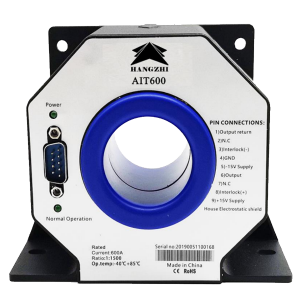
Selecting the right sensing technology starts with the electrical conditions rather than the sensor label. An industrial current sensor should be evaluated against current range, AC or DC operation, accuracy, isolation, bandwidth, thermal behavior, response time, physical installation, and acceptable power loss. Shunt, Hall-effect, current transformer, Rogowski, and fluxgate architectures each solve different measurement problems.
For systems where long-term precision matters, Fluxgate Current Sensors can provide a useful combination of galvanic isolation, low drift, and accurate measurement across changing operating conditions. Hangzhi applies multi-point zero-flux control to high-precision current and voltage transducers, with published accuracy reaching 10 ppm and measurement ranges extending to 30 kA.
Start With the Electrical Requirements
Current rating alone provides an incomplete basis for sensor selection. A device specified for 500 A, for example, may perform very differently depending on whether that value represents continuous current, short-duration peak current, bidirectional DC, or a rapidly switching waveform. The initial specification review should define nominal, peak, fault, and minimum measurable current separately. Voltage level matters just as much because the sensing architecture must fit the system’s common-mode and isolation requirements.
Bandwidth deserves similar attention. A measurement path used for energy monitoring may not need the same dynamic response as one feeding a converter control loop. Excessive bandwidth can also admit switching noise, while insufficient bandwidth can distort transient information. An industrial current sensor should consequently be assessed through its usable frequency range, propagation delay, settling behavior, and waveform requirements rather than through bandwidth alone.
Compare Shunt, Hall, and Fluxgate Current Sensors for Industrial Projects
Shunt sensing remains attractive because the measurement principle is straightforward: current passes through a precisely characterized resistance and the resulting voltage is measured. It can provide strong linearity and high accuracy, particularly at modest current levels, but the resistance also creates insertion loss and heat. As current rises, even a very small resistance can produce meaningful dissipation.
Hall-effect sensing takes a different route by detecting the magnetic field around a conductor. The approach supports isolated AC and DC measurement while avoiding the substantial series loss associated with a conventional shunt. Its practical advantages include flexible mechanical arrangements and relatively simple integration, although offset, temperature behavior, external magnetic fields, and mechanical positioning need attention.
Fluxgate Current Sensors use magnetic excitation and null-detection techniques to measure current with very low offset and drift. That makes the architecture particularly relevant to precision DC measurement, bidirectional power systems, calibration equipment, and applications where small measurement errors accumulate over long operating periods. The trade-off is greater circuit complexity and, in many designs, higher cost than simpler magnetic sensing methods. For current sensors used in industrial projects in 2026, this architecture comparison should be tied to the project’s accuracy, isolation, and dynamic requirements.
Match Accuracy With the Real Error Budget
Accuracy should never be treated as a single number disconnected from operating conditions. A specification may describe initial accuracy at room temperature, while the finished equipment experiences temperature changes, magnetic interference, supply variation, ADC errors, and mechanical tolerances. A realistic calculation should distinguish offset, gain, linearity, noise, thermal drift, and time stability before comparing competing technologies.
Low-current behavior deserves particular attention. A sensor with a wide nominal range may appear suitable for a high-power application, yet its relative error can become significant near the lower end of that range. Precision applications may consequently benefit from a sensing architecture capable of maintaining small offset and stable gain across a broad dynamic range.
For Fluxgate Current Sensors, stability can be particularly valuable because the measurement principle supports precise detection of magnetic flux around a controlled operating point. Hangzhi’s multi-point zero-flux approach combines excitation-flux control, self-excited fluxgate technology, and multiple closed-loop controls to maintain measurement performance across the working range. The architecture also supports detection of AC, DC, and high-frequency ripple components, making it relevant where several current characteristics must be observed through one measurement system.
Consider Isolation, Installation, and System Integration
Galvanic isolation can simplify the interface between a high-voltage power stage and low-voltage control electronics. Shunts normally require additional isolation techniques when the measurement point sits at a high common-mode potential, whereas magnetic sensing architectures can inherently separate the measured conductor from the signal electronics. The required isolation rating, creepage, clearance, insulation system, and transient withstand capability should still be checked against the actual installation.
Mechanical conditions can influence magnetic sensors as much as electrical specifications do. Busbar geometry, conductor position, nearby ferromagnetic materials, phase-to-phase spacing, and enclosure construction may affect the magnetic field seen by the sensing element. A technically strong industrial current sensor can still produce inconsistent field measurements if its mounting environment differs significantly from the conditions used during calibration.
Conclusion
The most suitable sensor is the one whose measurement characteristics fit the electrical and mechanical realities of the project. Shunts can make sense where low loss is manageable and direct measurement accuracy is important; Hall architectures offer isolated AC/DC sensing with practical integration; fluxgate technology becomes especially compelling as low drift, linearity, and long-term precision gain importance. A well-defined error budget, realistic temperature testing, appropriate isolation, and careful mechanical design provide a stronger basis for selection than current rating alone.
Fluxgate Current Sensors deserve consideration whenever precision must remain dependable across changing loads and operating conditions. Hangzhi offers a multi-point zero-flux approach for applications requiring high-accuracy current and voltage measurement, while technical teams can contact us through the company’s designated contact channel to discuss application-specific requirements.
The About Hangzhi page provides additional background on the company’s development of high-precision electrical measurement technology. Its approach centers on fluxgate-based measurement and multi-point zero-flux control, with attention to accuracy, stability, and low drift. Such information can help technical teams understand the engineering philosophy behind the sensing architecture rather than evaluating a device only through a single headline specification.
